This blog was created to explore the sexual, racial, and feminine identities portrayed in the postcards of Postsecret. When I started out with this blog, I began by questioning the purpose of Postsecret and the need for secrets and how they affect us. I briefly touched upon family secrets - because family is the first and smallest network a person is involved in and affected by. I also talked about why Postsecret might help people relieve the burden of their own identity. My main focus, however, was how society creates secrets and shameful feelings and makes people feel bad about their thoughts and themselves. All of the postcards I selected to analyze are peoples way of voicing their opinions and to make their secret someone else's secret as well.
As Guy Debord said in our reading"Society of the Spectacle", "the spectacle is not a collection of images, but a social relation among people, mediated by images" (page 1, #4). Postsecret is a spectacle. It is a "social relation among people" and they use images and text to create this relation. I find the idea of Postsecret genius - it spreads what people think are secrets or shameful and are accepted by a community. The postcards of everyday people show secrets that American society would accept and others that open our eyes to new ideas and feelings. I really enjoyed making this blog and exploring the identities represented in Postsecret, and I hope this blog can show how Postsecret is a way of visualizing different identities such as femininity, sexuality, and race.
Sunday, March 9, 2008
The Sexual, Racial, and Feminine Identities of Postsecret

The Racial Identities of Postsecret


Racial identity is less frequent in Postsecret but it comes up in a lot of the postcards that people send in. In this postcard on the left, the artist uses the media (Black Entertainment Television) to portray a side African American culture. I find this postcard interesting because it uses modern media and shows how racial identity is associated with it. On the right, a postcard shows how racism is complex and still a big part of society. The theme of social constructions is evident in most Postsecret entries. These entries show people trying to cross boundaries, trying to show that there shouldn't be boundaries in terms of sexuality, race, and femininity. The image on the right shows the complexities that are associated with racial identities. Is the woman who created the image on the right ashamed of her racist husband, or the fact that she has to hide the relationship in general? These postcards portray such meaningful messages that question society in the United States.
 This postcard to the left about the house-keepers at UVM opens people's eyes too how racial identity in institutions are viewed. Sent by a white person, this postcard shows the racial identities of many people and how they are treated by institutions like schools as big as universities. I think this postcard really speaks for itself, but I thought it was necessary for this blog. It is relevant to the students here and I think this Postsecret artist shows that despite the anti-racism movements at schools, it still exists and is a problem.
Finally, it is interesting to see how the media and American culture affect racial identity. Below, this postcard shows the secret wish that this woman has to have babies like Angelina Jolie. It is interesting to see that popular magazines and television have shown this diverse family in a positive spotlight, unlike the postcard above that discourages inter-racial relationships. 
Sexuality in Postsecret
In Arlene Stein's article, "Three Models of Sexuality: Drive, Identities, and Practices", she states that sexuality is conformed mostly by society and what is thought to be right and wrong in terms of social standards. While she also mentions that sexuality can be affected by family and religion, she notes that sex is a social construction, and that sexual orientation is also socially constructed. This explains why the postcards from Postsecret seem shameful or guilt ridden. Because people feel that society won't accept their secrets, they send them into Postsecret to get them off of their chests and perhaps to see if anyone else can relate to them.

For instance, this postcard seems like the artist was ashamed of their feelings. It might sound silly and strange, but why has society made "watching men eat meat" twisted and not sexually arousing?
Because society has constructed a definition of what is sexy and what isn't, feelings like the postcard to the left are turned into secrets and embarrassments. This photo below, shows the shame someone feels for fantasizing about breast feeding. The socially constructed ideas for what is "hot" and what is not has rejected the idea that it is OK to fantasize about breast feeding. Thus, this person feels shame and guilt for having these feelings- turning them into a secret.

Other fantasies that are rejected by society are those of gay or lesbian people - or those in between. On the right depicts a person who's identity includes both lesbian and straight sexuality. This person, whose gender is unknown to the reader, is clearly upset that he or she is having these feelings because if their husband found out, he would probably feel hurt and betrayed. The creator of these postcards is not the only one affected by these secrets. If these postcards weren't anonymous, they would probably hurt more than just the secret keeper. Because society has built up such expectations and constructions, everyone who knew these people would be seriously affected by these secret identities - secrets like the postcard below.  While some of these postcards portray adultery which is not commonly accepted, they also show people unhappy with their sexual orientation or unhappy in a relationship that perhaps was forced upon them by the standards of the community they live in.
The gay and lesbian community also shows the pressures of society. In the image below, a gay person has shown how he feels society treats him according to his sexual orientation. I wonder what this postcard really means. Is he saying that society as a whole would deny that they think of him differently because he's gay? Because this is a secret, maybe society doesn't know how it accepts gay people, or how it doesn't accept gay people. Postsecret is a complex medium in which people can voice how society views them and their decisions.
Postsecret also portrays many stereotypes of sexuality of men and women. This postcard on the right makes something that is usually a male pleasure into something that is OK for females to do as well. By putting a voice and image to sexuality, the postcards on Postsecret cross boundaries that have been created by society.
Feminity in Postsecret

Femininity is a common theme in postsecret entries. Many women send in postcards of how they see themselves. This particular postcard (left) shows how obsessed this woman is with her own image. Other beautiful women affect her so much that she cannot deal with her own identity.


Femininity is a common theme in postsecret entries. Many women send in postcards of how they see themselves. This particular postcard shows how obsessed this woman is with her own image. Other beautiful women affect her so much that she cannot deal with her own identity. Postsecret shows women's fear of their own feminine image. Weight problems arise a lot on Postsecret, and fears that people will find out about the image behind the postcard are also featured on post secret. Insecurities about body image, whether it is weight, looks, or the body in general, are portrayed through postsecret. Postsecret shows the pressures of society on women to have the beautiful feminine image of celebrities and other famous women that the media portrays.
Linda Kalof describes this affect that media has on women in her article "Dilemmas of Feminity: Gender and The Social Construction of Sexual Imagery". She studies the reaction of men and women after watching a Michael Jackson music video on MTV in the 80s. She noted the intense gender construction of the female but didn't notice as much of a concentration on the male body. She focuses on "the intersection of gender, sexuality and power" (Kalof p.639) in the video and how society interprets it. Kalof talks a lot about how historically, women have always been really aware of their attractiveness and body image because they want to impress men, thus women are often self conscious and insecure mainly because they fear being alone and without a man. Postsecret features a lot of these women - women who are afraid of how society will view their bodies and it is clear visually and textually in their postcards.
Family Secrets

Family secrets are another very common theme in postsecret. Because family, or lack there of, is part of everyone's identity, these postcards are very personal and telling. I always have heard, "every family has its problems" but family secrets are usually the last things people reveal about themselves. It is human instinct to show people who you are, and where you came from, but it is less popular to talk about imperfections. These postcards show the problems and the secrets that families cover up for a lifetime. These postcards seem to confirm that every family has its secrets, whether this intense and upsetting or less deep and powerful. I think that family has everything to do with identity and what you keep secret, and these postcards are an accurate portrayal of this part of peoples' identities.
Post Secret, Trash Can of Embarrassing Feelings

People also use post secret to dispose of their embarrassment. Somehow, making their embarrassing feelings known anonymously is comforting, and in a sense, it relieves their identity of some aweful and shameful events in their lives. By sending in these sad and mortifying secrets, people can retire from the constant reliving of their hard times. Maybe, by knowing that someone else knows your secret, you don't have to remember it all the time, and you can remove it from your identity.
Friday, March 7, 2008
What is Postsecret?
What is the point?
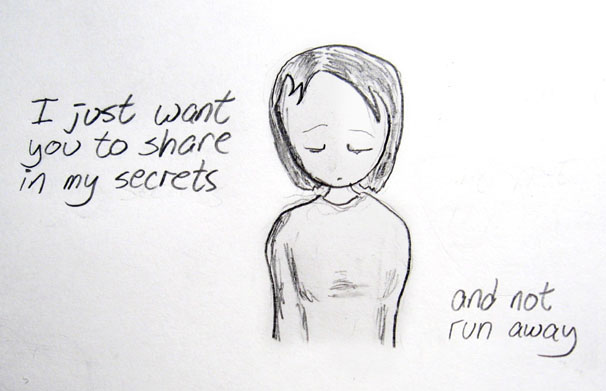
 So, what is the point of Post Secret? Why do people need to expose their most personal secrets? This portrayal of identity is complex. Post Secret allows people to tell their secret identity to the world (via internet or mail) and not experience any of the repercussions. Because they don't tag their name along with their secrets, these secret identities are just flying around the internet and in the mail instead of remaining a huge burden for the person who has been keeping it private.